What is the Importance of Thermal Pads in Circuit Board Manufacturing?

By | Date posted: | Last updated: December 11, 2025
circuit-board-manufacturing

With the increased miniaturization of devices, the one thing that PCB manufacturers need to contend with is the generation of heat. Thermal management, therefore, becomes an important aspect especially since elevated temperatures make it difficult for the PCB to achieve its target performance and reliability levels.

Thermal Analysis

It is imperative that a detailed thermal analysis be undertaken. Simply put, thermal analysis refers to the process of establishing the thermal module of components and set simulation control parameters according to the structure as well as a raw material of the PCBs, package type of components as well as the operating environment of the PCB. A thorough thermal analysis undertaken in the concept phase will ensure that the exact values of component temperature, board temperature and airflow temperature are obtained, and effective heat dissipation techniques are therefore employed.

Good PCB Design Practice

Some of the PCB design and prototyping techniques that come in handy when it comes to thermal management include:

  • Use of Heat sinks
  • Use of thermal pads and thermal paste.
  • Use of solid filled vias
  • Using board material that has good thermal properties
  • Cooling fans placed strategically

While a heat sink is a preferred device that helps dissipate the heat, however, to ensure better connectivity between the IC and the heat sink, thermal pads and thermal pastes are used.

Let us look a little closely at these two heat-dissipating components.

What are thermal pads and thermal paste?

Thermal pad

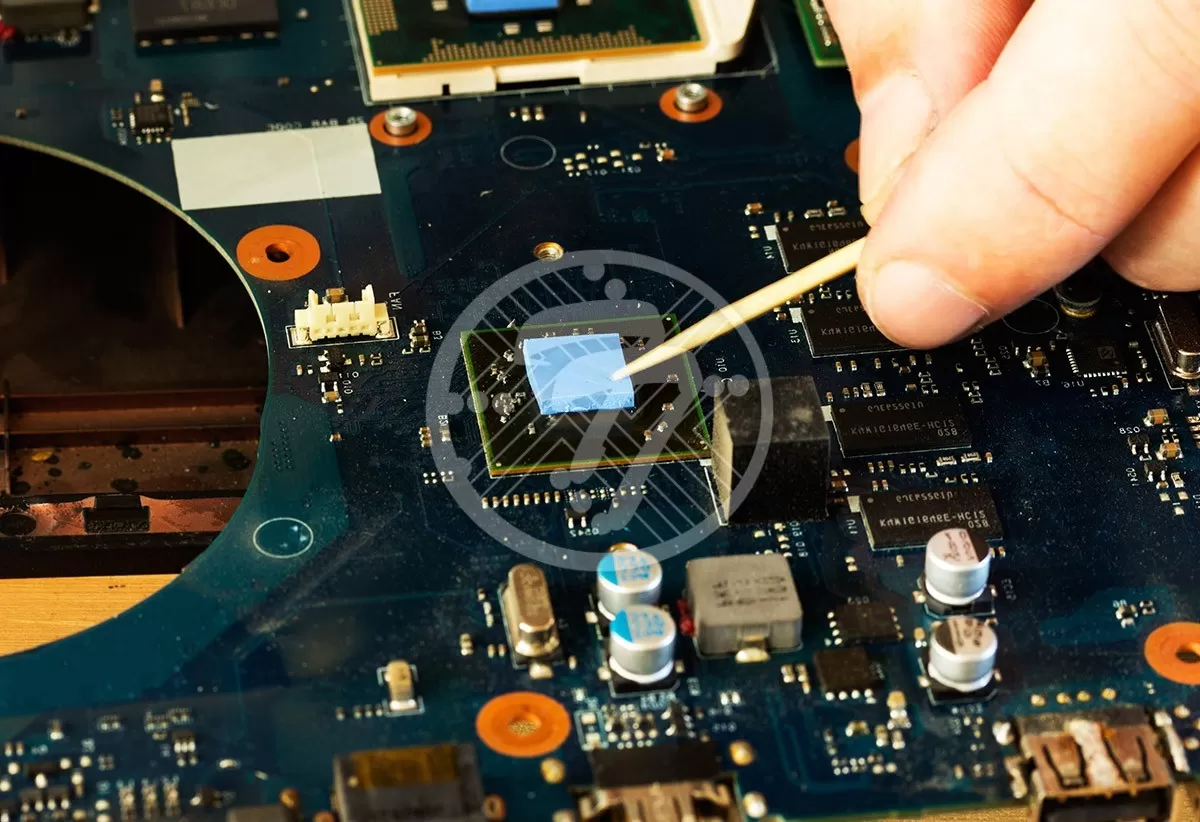
Simply put, a thermal pad is a large metal area on which a heat sink can be bolted. Thermal pads made up of thermally conductive material. When placed between the components and the heat sink, they help to dissipate heat easily.

The advantages of using thermal pads include:

  • They can be deployed easily
  • The material can be cut to the bespoke size required
  • They are available in a wide range of materials

However, they can turn out to be expensive. Also, cutting and fitting the material will need effort and time.

Thermal paste

In essence, the thermal paste performs the same function as a thermal pad. The principle that it works on is that it closes any air gaps between the heat generating components and the heat sink. This ensures that the air gaps do not act as thermal insulators and the heat is dissipated easily. There are a wide variety of factors that influence the choice of thermal paste. Some of the factors that go into the selection include:

  • Thermal Conductivity
  • Viscosity
  • Pump-out resiliency
  • Dry-out resiliency

The advantages of using thermal paste includes:

  • It is inexpensive.
  • Its application is fairly easy.
  • It is more durable as compared to a thermal pad as also sturdier.

However, the application of the paste can be a messy affair. Also, the thermal paste does not have as much strength as a thermal pad.

What works better – thermal pad or thermal paste?

There really isn’t a one-size-fits-all answer to that. The choice of one versus the other is really dependent on the application and the bespoke needs of the board. In certain application the use of both is prudent. Typically thermal paste is preferred where:

  • The PCB has high component density
  • The PCB has power components
  • The PCB thermal profile shows thermal hotspots

What is a thermal relief pad?

While discussing heat dissipation techniques, it will also be prudent to touch upon the subject of thermal relief. Essentially, it is a technique used by PCB manufacturer that involves thermally separating solder pads from large copper areas so that excessive heat transfer does not occur from the pads during the soldering process that could result in a delay in melting of the soldering alloy. While its advantages from the Circuit Board Manufacturing standpoint are known, there are concerns regarding the under-utilization of heat transfer capability of large copper areas. In turn, this might lead to localized thermal hot spots at component terminals.

To sum up
To sum up, thermal management of the PCB involves several aspects including but not limited to:

  • Design of power planes
  • Trace Routing
  • Via Placement
  • Thermal Relief Pads and more

Experienced designers can go a long way in ensuring an efficient PCB design that ensures efficient thermal management.

Technotronix is one of the leading PCB (Printed Circuit Boards) manufacturers in the USA. We have over 4 decades of experience in providing innovative PCB manufacturing services using modern technologies and the latest machinery. We are adhering to strict high-quality standards and compliant with the RoHS (Restrictions of Hazardous Substance) directives. We can fulfil the varied needs of our customers from the simple board to the most complex board for PCB prototype to production.

Get a quick PCB manufacturing quote!

How to select the best Flex PCB Manufacturer for your next project?

By | Date posted: | Last updated: September 7, 2024
flex-pcb-manufacturer

PCBs, short for Printed Circuit Boards, play a crucial role in a wide range of electronic goods, from consumer electronics to computer devices. They are the foundational building blocks of electronic and electrical appliances. According to most experts, modern electronic devices are primarily assembled on PCBs before being sold in the market.

Before selecting the best PCB for your needs, it’s essential to understand why PCBs are indispensable. This article will provide insight into the importance of PCB board manufacturing and printed circuit board assembly. We’ll explore the key attributes and characteristics to consider when choosing the right PCB, along with various reasons, facts, and even price considerations.

Keep reading to learn more about how to choose the best Flex PCB manufacturer for your next project.

Why do you require to use PCB in the first place?

With the kind of complex electronics coming into existence today, traditional wiring isn’t much advantageous. Hence PCBs, when compared to conventional wiring, are much appreciated and used. That’s why we use Flex PCB in electronics today.

Not only that, PCB has many more significant advantages like high reliability, low production cost, Lightweight, less complex design, and requires less maintenance compared to other wiring systems.

Due to its advantageous features and less complex design, PCB is an integrated electronic circuit device.

What Industries PCB Manufacturers caters to?

As we’re heading towards creating smaller and more efficient electronics, we need to understand the needs of PCBs. PCB manufacturers cater to the Aerospace, medical, military, computer, telecommunication, and Instrumentation industry.

Here in this article, we’re offering comprehensive, detailed ways that you can look to choose the best PCB manufacturing industry.

Follow Proper Set of Guidelines to Select the Right Flex PCB Manufacturer

Good quality products become crucial when their processing is in a good way. It all depends on the workers who work inside the factory. Usually, production unit is the most sensitive space for mistakes to occur. Following the proper set of guidelines ensures the production is done in a good way and leads to successful PCB manufacturing.

So, whenever you’re looking for the best PCB manufacturing company, make sure you gain insight into its production chain. A clear and practical training enables proper chain management in PCB production.

Choose the company with the latest equipment in Flex PCB manufacturing.

Innovation is taking newer twists and turns with every passing day. Make sure when you’re seeing the next PCB manufacturing unit check to see if their product has the latest technology incorporated into them.

You can’t be having old designs for newer requirements. The manufacturing unit must be well versed in leading innovative techniques and technology.

Check their machinery models and check the quality of materials that go into Production by inspecting other crucial aspects. Good tools and machinery affect the PCBs’ quality and quantity and ensure circuits works and meet the latest standards.

If the manufacturing unit uses old and saggy machines, there are high chances that the product’s overall quality and quantity will be poor. Hence avoid choosing a product manufacturing company that works with the traditional methods of PCB manufacturing.

Understand the quality of flex PCB Manufacturing

Understanding the quality control of the PCB production is essential. You must lookout for a manufacturing unit that’s quite serious about Production with quality control. And you cannot trust a company that outsources testing controls to another party.

Quality of printed circuit board manufacturing is crucial in manufacturing the PCB units and the best PCB designer know how to maintain the quality of PCB supplies to their clients.

For Printed Circuit boards, there are hardly three assembly inspections. The first one is a visual observation, where experts perform the testing of soldering components.

Upon that inspection, the report helps to find out if all the processes are fit and fine. These different kinds of examinations are significant for understanding choosing the best PCB manufacturing company.

Flex PCB Primary stock

As a responsible PCB manufacturer, their primary stock must be up to content. Flex PCB manufacturing company must include resistors, capacitors, inductors, and other elements.

The minimum order quantity of these primary things must be ranging from 4000 to 5000 pieces per the product reel.

The inspection of these things is crucial to ensure the manufacturer is the right one.

Check flex PCB Manufacturer reputation

People would not waste even a single penny on cheap, fewer quality products. That’s why always check out the reputation of the PCB manufacturing company.

Hence, it’s essential to choose a flex PCB supplier that’s well-reputed among the respective audiences. Its customer reviews reflect the company’s efficiency. You can contact their prior customers to understand how they work, what they offer, and the quality of PCBs they make.

A good reputation is one out of the hundred best ways to choose the best PCB manufacturing company.

These are the few steps or ways by which you choose the best PCB manufacturing company out of the rest. With the increasing demand for electronic devices for both secondary and ordinary people, PCBs Manufacturing companies are ground breaking.

But the problem is there are so many such companies out there; hence, choosing the best one could be challenging.

That is why we brought to you some ways by which you can compare different companies and choose the best one out of all.

You don’t require to brainstorm yourself into multiple options. Read this article, and you’ll be ready to choose the best flex PCB manufacturing company in comparatively less time.

At Technotronix, we have over 40 years of fabricating and assembling a wide variety of flexible circuit boards. With state-of-the-art equipment, we deliver the highest quality boards that you can rely on. Armed with an experienced flexible PCB manufacturer team that can advise you on industry best practices, what you get when you join hands with us, isn’t just a vendor but a partner who is invested in your success. No matter how complex your requirement, you can count on us to deliver to your bespoke needs. Our stringent quality control processes ensure that the boards deliver to your benchmarks. To more about custom flexible circuit boards, rigid-flex PCBs, flexible printed circuit boards manufacturing, flexible PCB prototyping get a quick quote!

Request a free quote for Flex PCB fabrication

What are the benefits of Prototype PCB manufacturing and why is it important?

By | Date posted: | Last updated: April 19, 2023
Prototype PCB manufacturing

Printed Circuit Boards or PCBs are one of the most essential components of an electronic device. To ensure the efficacy of the device it is imperative that the PCB remain error free. A very important step in this direction is Prototype PCB manufacturing. After all, you do not want a stage where you have manufactured the entire lot of PCBs and you detect an error, which proves to be extremely costly for you.

What really are Prototype Printed Circuit Boards?

Simply put, a PCB Prototype offers an opportunity for pre-production analysis for the final PCB. With a prototype you can check the design as well as the functionality of the final prototype. It allows you to make the necessary experimentation in order to arrive at the most efficient version of the PCB. There are several important steps in prototype PCB Manufacturing. These include:

  • Selecting the right material for prototype manufacturing.
  • Making a rapid design.
  • Testing the design for functionality
  • Rectifying any errors and designing, if need be.
  • Next follows the process of rapid prototyping where the PCB is manufactured.
  • The next stage is that of functionality testing. It is only when this stage is satisfactorily crossed that the PCBs are manufactured.

Throughout a project, several PCB prototypes may be used at various stages. Examples of these include:

  • Visual Models
  • Proof-of-concept Prototypes
  • Working Prototype
  • Functional Prototype

Benefits of Prototype Printed Circuit Board Manufacturing

Reduces Failure Rate

The biggest benefit of PCB Prototyping is that it reduces the failure rate of PCBs and saves you from potential, costly errors at a later date. Failure of a PCB has a number of implications including not just loss of time, effort and money but also loss of company reputation, in case the faulty PCBs make it to the market.

Design for Manufacturability

With a prototype it is extremely easy to test the feasibility of the PCB design. What gets a big impetus, therefore, are the aspects related to Design for Manufacturability as well as Design for Assembly. With a prototype in place, you cannot go wrong in these areas.

Improved Product Quality

What you gain significantly from a prototype, is the fact that since the prototype developer is aware of best practices, compliance regulations and more, the final product quality goes up significantly. You also tend to benefit from the high quality materials, state-of-the-art machinery and the overall expertise that a prototype manufacturer brings to the table.

Reduced Timelines

With a specialist PCB prototype contract manufacturer, you also tend to gain from the quick turn around time that they work with. With time to market being a major source of competitive advantage, this is of immense benefit. The improved timelines are also on account of the fact that Prototypes offer the following advantages:

  • They take the guesswork out of the equation and allow for complete testing
  • They minimize rework
  • Having a prototype of the final product as a visual aid minimizes the time spent on explanation of the final product, particularly if you are dealing with investors

Ability to check components individually

For complex projects, particularly, it is important that you be able to validate each component individually. This will help point out, where exactly there is an issue. Prototypes offer you that opportunity to test individual components and find areas of concern well in advance.

Reduced Costs

It may sound counter intuitive, but a prototype instead of increasing your project cost, lowers it in the long run. With your design team being able to catch any issues sooner, it saves you from costly errors and laborious reworks. Seen in perspective, prototypes therefore reduce project costs.

Also checkout: Price range for PCB prototypes

To sum up

In conclusion, it can be said that a Prototype is a powerful tool that is available which ensures the quality of the final product while offering benefits such as cost saving and reduced project timelines.

It is important however, that you choose the PCB prototype manufacturer with care. The right partner will not only assist you in developing your product, they will share important industry best practices that will save you the time and effort of reinventing the wheel.

We are providing defect free Prototype PCB Manufacturing services as per customer specification. Get a quick quote for PCB prototyping.

Best Practices of New Product Introduction (NPI) Manufacturing for Electronics Contract Manufacturers!

By | Date posted: | Last updated: December 11, 2025
New Product Introduction

Introduction of new products is a great deal. Electronics contract manufacturers know that NPI (New product introduction) is a must since it helps them to ease the complexities and move forward in the marketing community.

However, NPI is not the easiest thing to do if not implemented properly. Thus, electronics contract manufacturers need to work on several complex designs and carefully market everything. Such production requires an adequate amount of effort and costs to become a success. It should have high-quality total volume production for faster marketing.

Below, we will discuss the New Product Introduction for Electronic manufacturers and its best practices and advantages.

What’s New Product Introduction (NPI)?

NPI, short form for New Product Introduction, means those activities that introduce a new or improved product. It includes the definition, layout, development, prototyping and even the launch of a product. The product doesn’t have any limitations – it can be anything.

It aims to get a final working prototype that can help one to get a faster market. People also call it NPD, short for New Product Development.

Here, the engineer’s work is to keep drafting new concepts for their product until the final prototype is ready, including any required design alterations.

NPI Manufacturing Best Practices

Now that you know NPI, it’s time to get to its best practices, which are as follows:

Define and prepare objectives

Beginning with defining is the crucial step of New Product Introduction. The electronic contract manufacturers make sure that the essential aspects of the product are described in this phase. From budget and features to functions and requirements, everything is defined.
The Quality Function Deployment or QDF process is used to alter the functional requirements into designs.

Feasibility

Feasibility is another crucial practice of NPI, where the product’s success rates are analyzed. Here, the overall discussion regarding the manufacturing, preliminary design approaches, implementation, and time estimates occurs.

Development

The electronic contract manufacturing services also include a product’s development. Its overall designs are verified in this phase that consists of DFM or Design for Manufacturability and DFA or Design for Assembly. It has methods, DFM/A reviews, guidelines, BOM or bill of materials, etc.

Tests and implementation

After the development comes a product’s testing; the overall functionality of a product is tested, including its weaknesses and strengths. Its design, manufacturing, quality, concepts, etc., are analyzed thoroughly in this phase.
Once the testing is over, it goes to the implementation phase, where a product’s documentation is produced. It includes all the catalogs, manuals, and documents of a product.

Evaluate

Improvement is an essential factor in NPI. Electronics contract manufacturers can improve their products if they get adequate feedback and reviews which is what the evaluation phase of NPI covers. Here, the overall performance of the product is reviewed, and feedback is taken into account.

Production – The last & final phase

Once all the phases are clear, the last step comes forward. It includes the full-scale production of the product to be sent to the market and put to use.

Benefits of New Product Introduction (NPI)

NPI is proving to be an incredible way of producing successful products, and electronics contract manufacturing and assembly services are including it to improve the products. Some of the benefits of NPI implementation comprises:

Reduced Development Costs

As the electronic contract manufacturers consider the product’s design and its issues before the production, it enables cost reductions. There will be no additional costs of alterations, design changes, or tests if it all gets taken into consideration earlier.

Efficient production process

The electronics contract manufacturing services make sure to adopt DFM and DFA (Design for manufacturability and Design for Assembly) for the NPI. It makes the production process more efficient. It enables them to produce high-quality products properly.

Market capabilities acceleration

Usually, competition can be noticed for the marketing of products. If the electronics contract manufacturers cannot fulfill the consumers’ demands (fast delivery of the products), marketing errors may occur. Since NPI makes sure not to give rise to any manufacturing issues, it is possible to deliver the outputs faster, accelerating marketing capabilities.

Better product quality

In NPI, the proper design of a product is always considered to produce better outputs. Thus, it helps in increasing the overall quality of a product, which can be pretty beneficial.

Increased customer satisfaction

In NPI, the performance and functionality of a product are adequately tested, and the electronics contract manufacturers make sure to run everything smoothly. It helps in a better performing product’s production. As the functionality is better, customer satisfaction will improve as well.

Conclusion
Thus, we can say that NPI implementation includes various steps that prove highly beneficial for both electronics contract manufacturers and the consumer. NPI practices include all the design, manufacturing, testing, performance, and functional aspects of a product, resulting in high-quality output.

Technotronix has 4 decades of experience in prototyping of new product introduction processes. We are ISO 9001:2015 Certified and AS9100 registered PCB Assembly company with state of art manufacturing plant, highly trained workforce, industrial leading equipment, automated tooling and commitment to quality. From initial design, development, PCB prototype to full scale production and after-market support, Technotronix can provide you a complete package of industrial electronics manufacturing. To get more information about NPI implementation reach us at [email protected] or at 714/630-9200.

Request a Quote for NPI PCB Prototypes!